Introduction
We talk about data the way previous generations talked about oil — as a resource to be extracted, refined, and consumed. But this analogy breaks down in one crucial way: oil is spent when you use it. Data is not. Share it, analyse it, licence it, combine it with other data — it remains. In fact, it often grows more valuable in the process.
This is why data is not just a resource. It is becoming a currency.
The Data Value Chain framework maps how raw, unprocessed data travels through six stages to become what I call data currency: a strategic asset that confers economic power, institutional influence, and competitive advantage — not unlike money, but governed by entirely different rules.
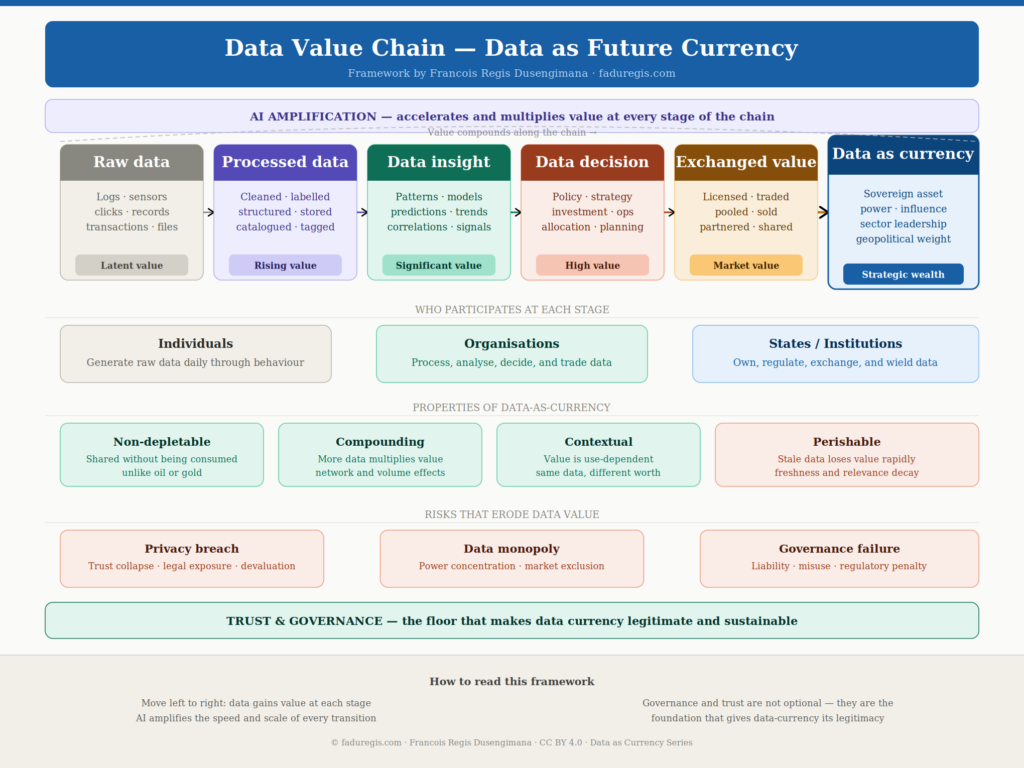
The Six Stages of the Chain
Stage 1 — Raw data
Everything begins here. Logs, sensor readings, clicks, transaction records, patient files, satellite imagery, social interactions — the unfiltered output of human and machine activity. At this stage, data has latent value: enormous potential, but none of it realised. Raw data on its own is inert. It answers no questions, guides no decisions, creates no leverage. Most organisations sit on vast quantities of it without knowing what they have.
The danger at this stage is not absence of data — it is absence of awareness. Institutions that do not know what data they hold cannot begin to unlock its value.
Stage 2 — Processed data
Raw data becomes processed data through cleaning, labelling, structuring, and storage. Duplicates are removed. Fields are standardised. Records are linked across systems. Metadata is attached. The data becomes findable, usable, and trustworthy. Value begins to rise — not because the underlying facts have changed, but because the data is now accessible and reliable.
This stage is unglamorous but foundational. No insight is more trustworthy than the data it is built on. Institutions that skip or rush this stage build on sand: their analyses are contaminated, their models are biased, and their decisions are misinformed without anyone realising it.
Stage 3 — Data insight
This is where processed data is put to work: statistical analysis, machine learning models, pattern recognition, trend forecasting, correlation mapping. The output is insight — an understanding of what the data means, what it predicts, what it reveals. Value rises significantly here because insight is interpretive. It requires skill, domain knowledge, and analytical infrastructure that most organisations do not have.
Insight is also where AI creates its most immediate leverage. A model trained on well-processed institutional data can surface patterns no human analyst would find in time to act on them. This is why AI amplification — the top band of the framework — is not an afterthought. It accelerates every stage, but it transforms this one most visibly.
Stage 4 — Data-driven decision
Insight only creates value when it changes behaviour. This stage is the bridge between knowing and doing. Policies are adjusted. Investments are redirected. Operations are redesigned. Strategic priorities are reordered. A government uses population health data to reallocate hospital funding. A university uses enrolment trend data to restructure its course offerings. A central bank uses payment flow data to detect systemic risk before it crystallises.
This is where data earns its place in the boardroom and the cabinet room. Institutions that reach this stage have transformed data from a technical asset into a strategic one. The gap between Stages 3 and 4 — between generating insight and acting on it — is where most organisations stall. It is a culture problem as much as a capability problem.
Stage 5 — Exchanged value
Once an institution consistently derives strategic value from data, the next step is to participate in data markets. Data is licensed to partners, traded within sectoral consortia, pooled with peer institutions for mutual benefit, or sold as a product. This is data as a commercial asset — one that generates revenue streams, unlocks partnerships, and positions the institution within broader data ecosystems.
This stage marks a philosophical shift. Data is no longer just an internal resource; it is a contribution to an external economy. The institution that controls rare, high-quality, well-governed data holds a negotiating position analogous to a country that controls a scarce natural resource — except, again, with the crucial difference that sharing the data does not diminish it.
Stage 6 — Data as currency
At the apex of the chain, data becomes currency in the fullest sense: a medium of exchange, a store of value, and a unit of account for power and influence. Institutions at this stage do not merely use data or sell it — they wield it. Their data assets give them geopolitical weight, sectoral authority, and the capacity to shape standards, regulations, and ecosystems.
This is not a distant or hypothetical stage. It is already operating. The largest technology platforms have achieved it. Nations that have implemented comprehensive data sovereignty frameworks are moving toward it. Health systems, financial regulators, and central banks that sit on uniquely comprehensive datasets are beginning to understand that their data reserves are as strategically significant as their financial reserves.
The Two Bands: What Makes the Chain Run
AI amplification
Artificial intelligence sits above the entire chain because it accelerates every transition within it. AI helps institutions process data faster and at greater scale (Stage 2), build more powerful predictive models (Stage 3), make decisions with greater speed and confidence (Stage 4), and identify data exchange opportunities they would otherwise miss (Stage 5). The institutions that will reach Stage 6 fastest are those that have integrated AI not as a bolt-on tool but as a core capability woven into every stage of their data value chain.
Trust and governance
Governance sits below the entire chain because it is the foundation on which every stage rests. Data that is collected without consent, stored without security, analysed without accountability, or exchanged without transparency does not become currency — it becomes liability. The legitimacy of data-as-currency depends entirely on the trust that surrounds it.
Governance is not a compliance checkbox. It is the institutional infrastructure — policies, oversight bodies, audit mechanisms, ethical frameworks, regulatory engagement — that gives data its credibility. Without it, even the richest data assets are unstable. A single breach, a single misuse, a single regulatory failure can collapse the value that took years to build.
The Four Properties of Data Currency
Unlike conventional currencies, data currency has four distinctive properties that institutions must understand.
It is non-depletable: sharing data does not reduce it. An institution that licences its data to ten partners still holds the same data. This is fundamentally different from oil, gold, or capital. It means data can be monetised repeatedly and simultaneously — but it also means that hoarding data purely for exclusivity is a weak strategy in the long run.
It is compounding: more data generates more value, non-linearly. A dataset that covers one year is useful; the same dataset covering twenty years is transformative. Data from one city is informative; data from a hundred cities is predictive. The institutions that begin building their data assets earliest will have structural advantages that latecomers cannot easily overcome.
It is contextual: the same data is worth radically different amounts depending on who holds it, what it is combined with, and what decisions it informs. A hospital’s patient flow data is moderately valuable to the hospital itself. Combined with pharmaceutical research data and public health records, it becomes extraordinary. Value is not intrinsic to the data — it is created through combination and application.
It is perishable: unlike gold, data decays. Yesterday’s consumer behaviour data is less valuable than today’s. A three-year-old traffic model may actively mislead planners working with a city that has grown. Institutions that treat data as a permanent archive rather than a living asset will find that what they hold depreciates faster than they realise.
The Three Risks That Erode Data Value
Privacy breach is the most immediate and reputational risk. A single significant breach does not just create legal exposure — it destroys the trust that underpins the institution’s ability to collect, hold, and exchange data at all. When data currency loses trust, it loses value, just as a national currency collapses when the government that backs it loses credibility.
Data monopoly is the systemic risk that arises when data assets become too concentrated. An institution — or a small number of institutions — that controls access to critical data can extract rents, exclude competitors, and shape markets in ways that are ultimately damaging to the broader ecosystem they depend on. Monopoly is a short-term power that erodes the conditions for long-term value creation.
Governance failure is the slow risk that organisations underestimate until it is too late. Misaligned incentives, absent oversight, poor data quality controls, and regulatory non-compliance compound quietly until they produce a crisis that is both harder and more expensive to resolve than the prevention would ever have been.
Conclusion
The Data Value Chain is not a prediction about a distant future. It is a description of a transition already underway. The institutions that will define the next decade — economically, politically, socially — are those that understand data not as a byproduct of their operations, but as the primary currency of the world they are operating in.
Moving along this chain requires deliberate investment in each stage. It requires the infrastructure of processing, the capability of analysis, the culture of decision-making, the governance of exchange, and ultimately the strategic vision to see data not as something an institution has, but as something an institution is.