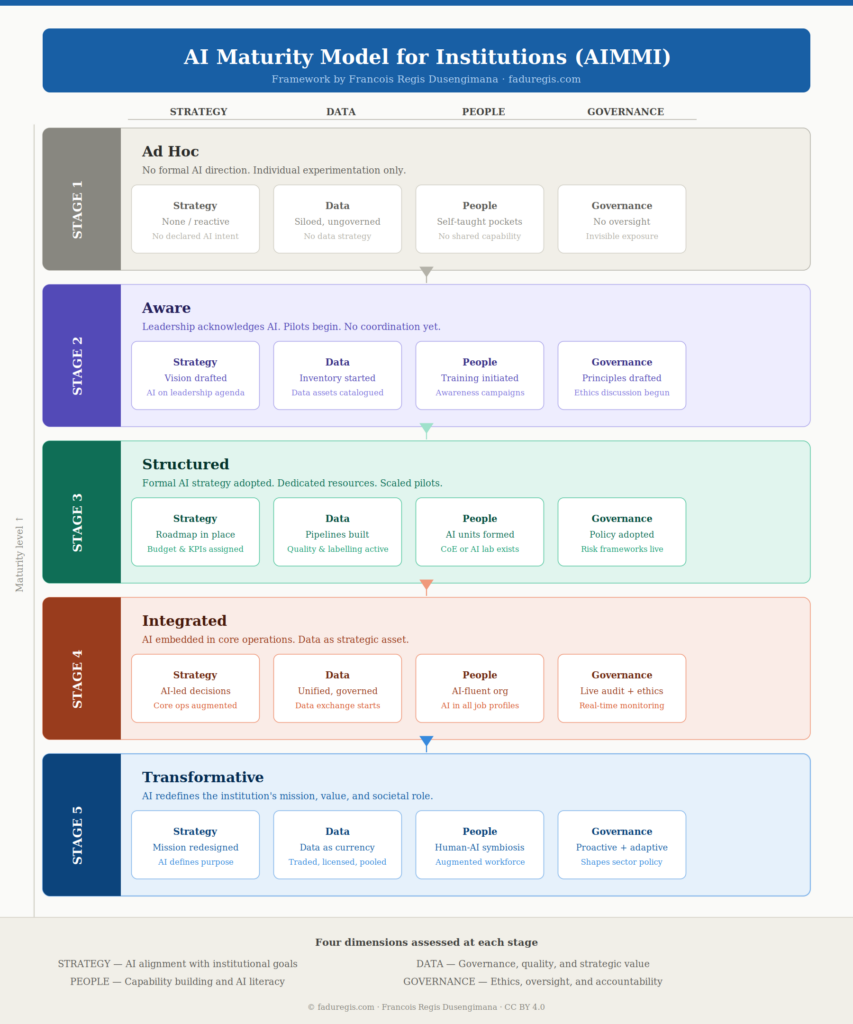
What is it?
The AI Maturity Model for Institutions (AIMMI) is a diagnostic and strategic framework that helps organisations — governments, universities, NGOs, corporations, and public bodies — assess where they currently stand in their AI journey and identify what it takes to move forward. It is not a technology checklist. It is a transformation map.
The model evaluates an institution across four dimensions at each of five stages:
Strategy — how deliberately and coherently AI is positioned in leadership decisions
Data — how data is collected, governed, and leveraged as a strategic resource
People — how AI capability is built, distributed, and sustained across the workforce
Governance — how accountability, ethics, and oversight are structured
The Five Stages
Stage 1 — Ad Hoc AI activity exists but is accidental. A data scientist in one department builds a model; a manager uses ChatGPT informally. There is no coordination, no shared vision, and no institutional awareness that these activities are happening. Data sits in silos. There is no governance because no one has thought to create it. The risk at this stage is not stagnation — it is invisible exposure: AI being used without accountability.
Stage 2 — Aware Leadership has noticed AI and declared it important. A vision or statement exists, perhaps a working group or a committee. Pilots are beginning — usually in isolated, low-risk areas. Training programmes are being scoped. The gap at this stage is the distance between intention and infrastructure. The institution knows it must move but has not yet decided how. Data inventory has started but governance remains aspirational.
Stage 3 — Structured This is the first stage of genuine institutional commitment. A formal AI strategy has been adopted with a roadmap, budget, and named accountability. Dedicated AI units or centres of excellence exist. Data pipelines are being built, not just planned. Policies have been approved, not just discussed. Pilots have been evaluated and some are scaling. The danger here is bureaucratic capture: the institution becomes good at planning AI and bad at deploying it.
Stage 4 — Integrated AI is no longer a project — it is woven into how the institution operates. Decisions in core functions (budgeting, service delivery, resource allocation, research) are informed or augmented by AI systems. Data is treated as a strategic asset: unified, governed, and actively monetised or exchanged. Most staff are AI-literate and some are AI-proficient. A live ethics and audit function operates in real time, not retrospectively. The institution is getting competitive or sectoral advantage from its AI capability.
Stage 5 — Transformative The institution has used AI not just to improve what it does, but to redefine what it is. Its mission, value proposition, and societal role have been redesigned around AI-enabled possibilities. Data is understood as currency — traded, licensed, pooled, or leveraged in partnerships. Human-AI collaboration is the default mode of work. Governance is proactive and adaptive, anticipating risks before they materialise. The institution is now a reference for others and likely shaping policy, standards, or ecosystems in its sector.
How to use this framework
As a diagnostic: Score your institution on each of the four dimensions (Strategy, Data, People, Governance) using the five stages as a rubric. You will almost certainly find you are at different stages across dimensions — for example, Stage 4 in People but Stage 2 in Governance. That gap is your priority.
As a communication tool: Use it in board presentations or strategy sessions to give leadership a shared vocabulary. Conversations move faster when everyone agrees on what “structured” means versus “integrated.”
As a planning guide: For each dimension where you identify a gap, map the specific investments, decisions, and changes needed to move one stage up. Don’t try to jump two stages at once — each stage builds foundational capacity for the next.
As a recurring assessment: Revisit the model annually. Maturity can regress (leadership changes, budget cuts, data breaches) as well as progress. The model is not a ladder you climb once; it is a compass you carry continuously.